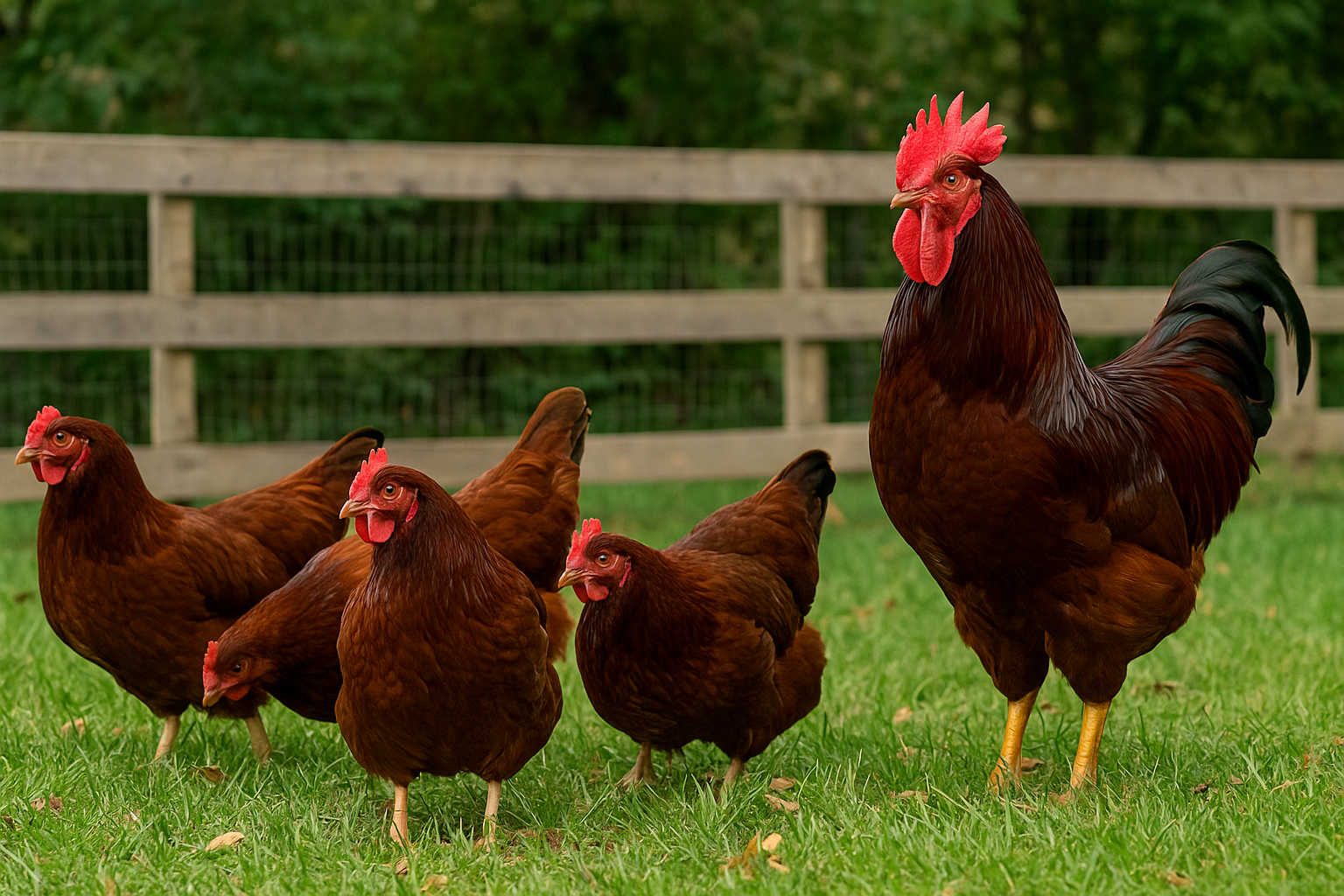
One of the most frequent problems among enthusiasts is managing inbreeding within their poultry group.
Inbreeding is a factor that should always be used to one’s advantage when selecting desired traits, but obviously, the downside is represented by unwelcome issues that eventually arise if inbreeding is excessive: decreased fertility, reduced size and hatching rates, weakening, and genetic defects. Inbreeding gives the breeder the opportunity to fix desired traits, but to avoid the problems highlighted above, one must try to avoid prolonged and indiscriminate mating between closely related specimens. The wise breeder will seek to avoid overly close inbreeding, preferring instead to work with linebreeding (mating between uncles and nieces/nephews, cousins, etc.).
But what should be done if one is breeding a rare breed and has space for only a limited number of breeding stock, with difficulties in introducing new blood? Whether trying to select a common breed or attempting to save an endangered breed, one can seek a strategy to manage inbreeding that maximizes positive results while minimizing damage. One of these successfully applicable techniques is Rolling Mating. Let’s look at the scheme together and then delve deeper into it:
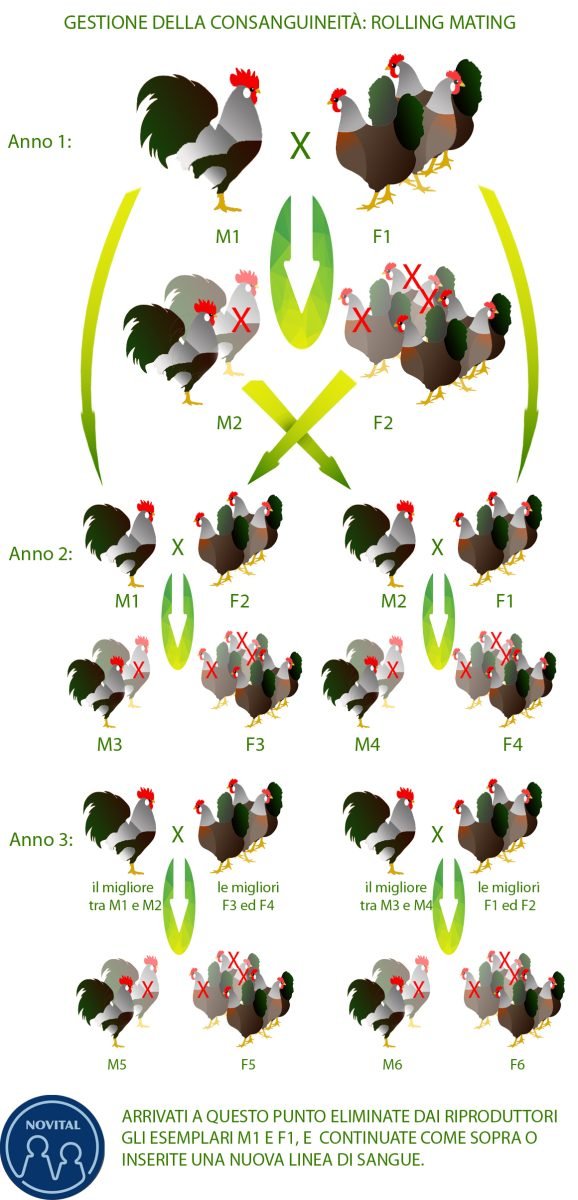
In the FIRST YEAR, you start with a breeding group consisting of one rooster (M1) and several hens (F1). Try to acquire the rooster from a DIFFERENT breeder than the one who supplied the hens, so that the animals are as unrelated as possible. Breed them to obtain a group of cockerels, from which you will choose and keep the best one (M2), and a group of equally good pullets (F2), removing the other subjects from the breeding stock.
In the SECOND YEAR, prepare two distinct breeding groups. The first will consist of the original male (M1) together with the best daughters (F2), while the second group will pair the best young rooster (M2) with the original hens (F1). From these two breeding groups, we will obtain two different groups of offspring: group 3 and group 4.
In the THIRD YEAR, we will again form two breeding groups: one composed of the best between M1 and M2, and the best hens F3 and F4; the other formed by the best rooster between M3 and M4, and the best hens from groups F1 and F2. This will yield two groups of young birds from which we will select M5 and F5 on one side, and M6 and F6 on the other.
At this point, in the fourth year before starting, we will remove any remaining subjects from the initial group (M1 and F1) from the breeding stock and proceed with the same pattern: the best specimens of the “old generation” are mated with the best subjects of the “new generation.” Alternatively, at this stage, we could try to introduce a new bloodline into our flock by practicing an outcross. However, this risks setting the breeder back in the selection of their strain, so it should always be used sparingly.
Rolling Mating is not the only technique for managing inbreeding, and other strategies exist to address the problem; we will analyze others shortly.
And do not forget that Novital is by your side every day in the breeding and selection of your poultry with its incubators and a wide range of poultry farming accessories. Visit our e-shop and discover all our products!